
Financial Pressures

The Town of The Blue Mountains is growing, but the cost and complexity of maintaining roads, pipes, buildings, and other services is also increasing.
The town has about 9,750 full-time residents today, up sharply from 2016, and local projections suggest the year-round population could exceed 11,500 by the end of 2026.
Because the town is a major four-season tourism destination, weekend and seasonal demand can significantly increase the actual number of people using local services.
That means the next council will have to make tough choices about taxes, debt, services, and long-term planning. This guide highlights the main issues in simple terms.
Infrastructure gap: about $8.3 million per year
2026 tax levy increase: 4.34%
Total 2026 budget: about $137 million
2026 landfill expansion budget: $2.5 million
What this means for voters: the town faces bigger bills for infrastructure and services, and those costs may show up through higher taxes, more debt, delayed projects, or reduced service levels.
Issue 1 - The Infrastructure Gap
Town-owned assets such as roads, bridges, water pipes, and buildings all need ongoing repair and replacement. The Town's Asset Management Plan, approved in February 2026, shows a major funding shortfall.
Each year, the town saves less for future repairs than it likely needs to keep up.[1]
Currently saved each year: about $5.9 million
Estimated need each year: about $13.9 million
The gap is about $8.3 million a year. In simple terms, the town is not setting aside enough money to maintain everything it already owns over the long term.
Town leaders have acknowledged that this financing gap is serious and will require long-term decisions.
The main options are straightforward:
Raise taxes to build reserves.
Borrow more to pay for projects sooner.
Delay some projects or accept lower service levels in some areas.
Issue 2 - The $19 million Project Cost Increase
Three major wastewater and road-related projects increased in cost from about $35 million to nearly $54 million. That roughly $19 million jump has become a major public concern.
For voters, the issue comes down to three questions: why costs rose, when the council was told, and how the town will manage the financial impact.
1. Why did costs go up?
Some cost increases may be due to inflation, labour shortages, and construction market conditions. Others may reflect problems with early estimates, project delays and re-engineering requested by Council, design scope, or project planning.
Question for voters: Were the extra costs mostly unavoidable, or could better planning have reduced them?
What to watch for: Candidates should explain clearly how they would improve project planning and cost estimates.
2. Was the council told soon enough?
A large budget jump is also an accountability issue. Voters should care about when warning signs appeared and when the council received a full report.
Town staff said warning signs appeared as early as August 2025, but the council did not receive a full report until December 2025.
Question for voters: How will candidates make sure the council hears about major overruns earlier?
What to watch for: Look for specific ideas such as mandatory reporting thresholds, regular financial checkpoints, or independent review.
3. How will the town absorb the cost?
A $19 million increase affects reserves, future borrowing, and the rest of the capital plan. It is even harder to manage because development charge revenue has also changed.
Question for voters: What is each candidate's plan to pay for these costs without creating unsustainable tax increases or cutting essential services?
What to watch for: Strong answers should explain priorities for reserves, debt, and future infrastructure spending.
How would they prioritize the capital plan
How would they rebuild reserves
How growth will help pay for growth in the future
Voters do not just need to ask whether the overrun happened. They should ask who has the clearest and most realistic plan to improve oversight and protect the town's finances.
Issue 3 - Rising Property Taxes
Council approved the 2026 budget with a 4.34% increase in the municipal property tax levy.
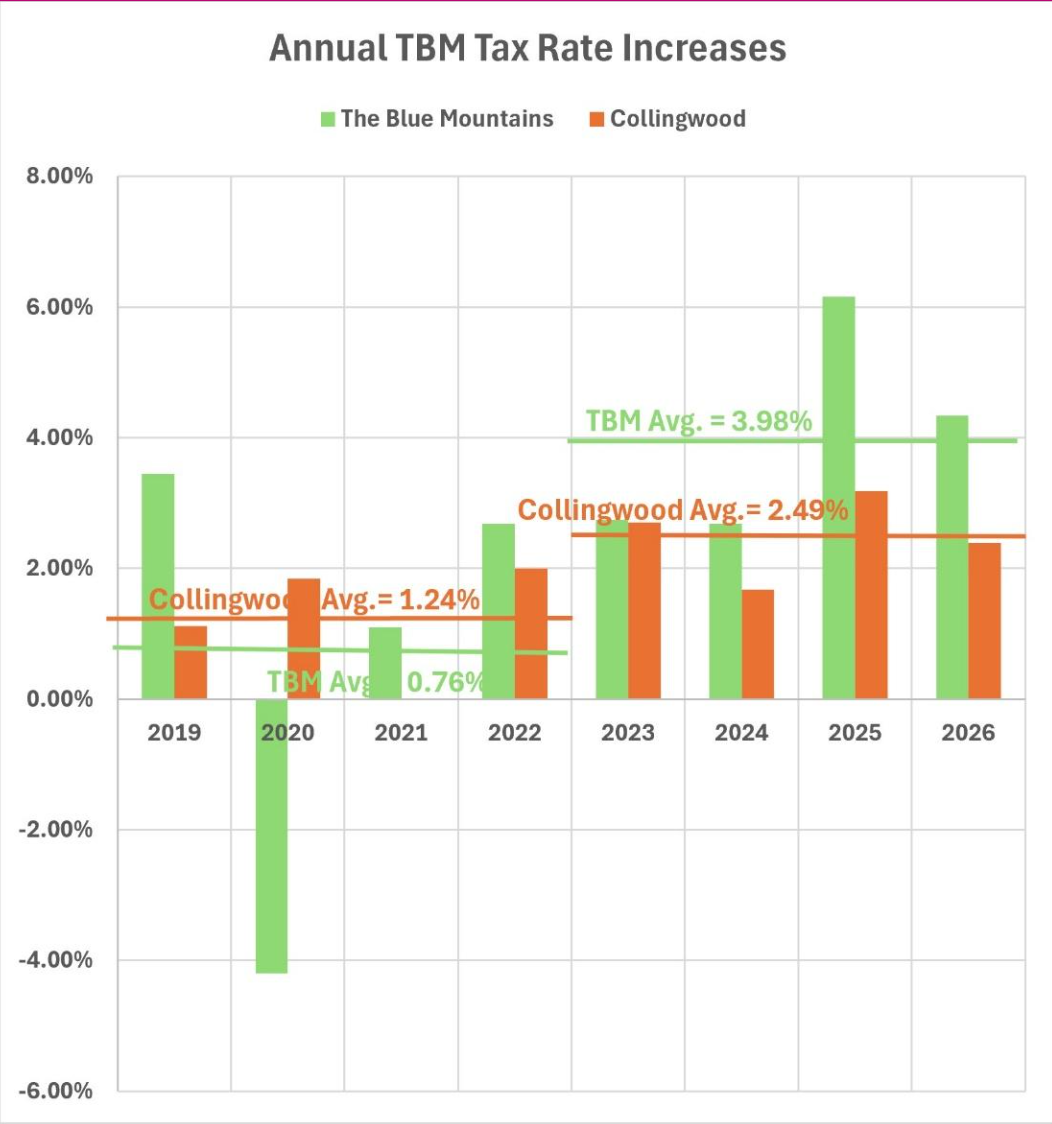
Historically, the Town had lower tax increases than Collingwood, and now they are higher.
For a typical homeowner, that means roughly:
A home assessed at about $530,000
An increase of about $97.55 per year, or about $8.13 per month
Part of the increase includes a $345,000 contribution to the Asset Management Reserve, but that is still only a small step toward closing the larger infrastructure gap.
The town's 2026 budget is about $137.3 million. Even with a smaller tax base than some neighbouring municipalities, the town also carries costs they do not, including running its own waste collection system and landfill.
Issue 4 - Landfill Costs
The town operates its own landfill, unlike some nearby municipalities. That creates extra costs and long-term financial pressure.
The 2026 budget includes $2.5 million for the next phase of landfill expansion.
Updated estimates suggest the actual cost may be higher. If the landfill is not expanded, the town may need more expensive alternatives, such as sending waste elsewhere.
Other notable capital items in the 2026 budget include:
$2.5 million for landfill expansion
$1.5 million for asphalt replacement
$25.3 million in provincial infrastructure grants
Issue 5 - Tourism Brings Money and Pressure
Tourism is a major part of the local economy, but it also increases pressure on roads, services, infrastructure, and housing.
To capture some tourism revenue, the town introduced a 4% Municipal Accommodation Tax in January 2025, including on short-term rentals.
This creates a new source of recurring revenue, but voters should pay attention to how future councils choose to use that money.
Short-term rentals and high housing costs have made it harder for many workers and families to afford to live in the community. The town has housing initiatives underway, but the need is larger than any single project.
One of the biggest questions for the next council is how to balance tourism revenue, short-term rentals, and housing affordability.
Issue 6 - Possible Service Trade-Offs
Town staff have identified possible ways to reduce costs. None have been adopted yet, but voters should understand what could be considered.
End the commercial Blue Box collection and shift the responsibility under Ontario's system
Reduce yard waste collection weeks
Borrow more for capital projects
Delay lower-priority projects
Accept lower service levels in some areas
All of these proposals consider the reduction of service levels. Has Council considered savings that are not driven by service level reductions?
The town is also updating its Community Improvement Plan, with a focus on housing, local economic renewal, and community resilience.
Issue 7 – Tax dollars going to Grey County
In 2026, the Town of The Blue Mountains taxpayers will fund 29% of the Grey County budget by sending $24.4 million in property taxes to Grey County. In return, Grey County maintains 77 kilometres of County Roads in the TBM (or 9% of the County roads), and operates 60 affordable housing units in the TBM (or 6% of the 997 housing units in Grey County). The County also operates paramedic services in Grey County.
Questions voters can ask candidates
Here are some simple questions voters may want to ask during the election:
How would you reduce the town's infrastructure funding gap?
What level of tax increase do you think is acceptable?
How should the Municipal Accommodation Tax be used?
What is your plan to improve housing affordability?
When, if ever, would you support more long-term debt?
Which services should be protected, and which could change?
Are we getting value for money for the services we receive from Grey County?
Does the Candidate support looking for costs/spending savings without reducing service levels?
